
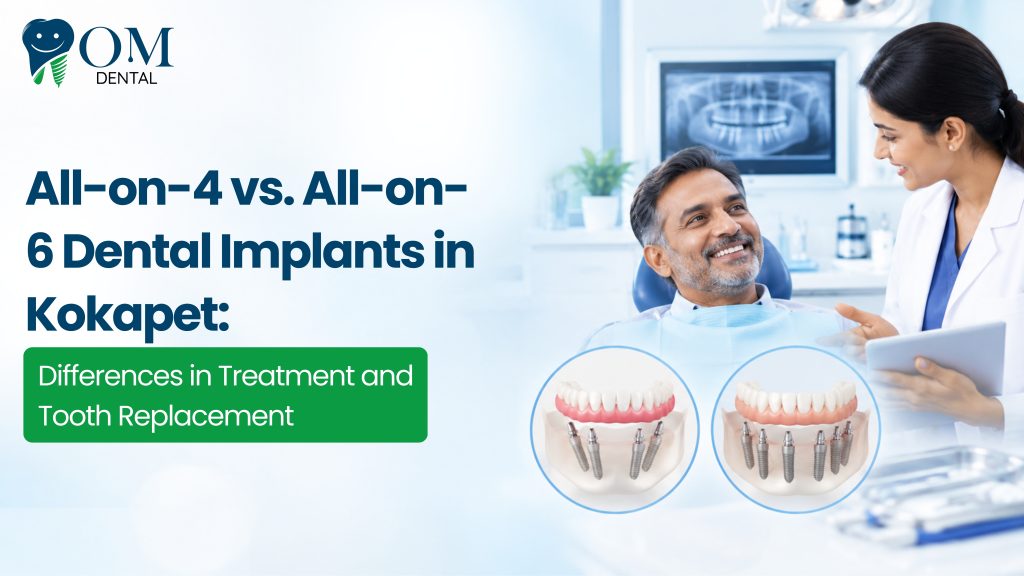
Replacing an entire arch of missing or severely damaged teeth can significantly improve chewing, speech, appearance, and overall oral function. For patients who need full-arch tooth replacement, implant-supported solutions such as All-on-4 and All-on-6 dental implants can provide an alternative to conventional removable dentures.
Both treatments use dental implants to support a fixed full-arch restoration, but the number and positioning of implants are different. All-on-4 dental implants in Kokapet generally use four implants to support a complete arch, while All-on-6 treatment uses six implants.
Choosing between these options depends on several factors, including bone availability, oral health, bite forces, treatment goals, and the dentist’s assessment. There is no single solution that is suitable for every patient, so a comprehensive examination is important before treatment planning.
All-on-4 and All-on-6 Dental Implants: The Basic Difference
The main difference between the two treatment approaches is the number of implants used to support the replacement teeth.
All-on-4 uses four strategically positioned implants to support a full arch of replacement teeth. This approach may be considered when the available bone and overall clinical conditions allow the restoration to be supported effectively with four implants.
All-on-6 uses six implants across the arch. The additional implants can provide more implant support and may be considered when the patient’s anatomy and treatment plan make additional implant placement beneficial.
The final decision should be based on an individual examination rather than simply choosing the option with more implants.
How All-on-4 Dental Implants Work?
All-on-4 treatment is designed to replace an entire arch using four dental implants. The implants are strategically positioned to provide support for a fixed prosthetic arch.
This can be particularly useful for patients who have lost most or all teeth in one arch or whose remaining teeth are not suitable for long-term restoration.
The treatment generally involves:
- Detailed dental examination
- Digital scans or dental imaging
- Assessment of bone and gum health
- Treatment planning
- Implant placement
- Healing and integration of the implants
- Placement of the final fixed prosthetic teeth
The exact sequence and timeline vary from patient to patient.
How All-on-6 Dental Implants Work?
All-on-6 treatment uses six implants to support a complete dental arch. The additional implants can distribute the support for the restoration across more implant positions.
For some patients, this approach may be considered when sufficient bone is available and additional implant support is clinically appropriate.
As with All-on-4, treatment planning involves assessing the jawbone, gums, bite, remaining teeth, medical and dental history, and the design of the final restoration.
All-on-4 vs. All-on-6: Key Differences:
| Feature | All-on-4 | All-on-6 |
| Number of implants | 4 implants per arch | 6 implants per arch |
| Full-arch replacement | Yes | Yes |
| Implant support | Four strategically positioned implants | Six implants distributed across the arch |
| Treatment planning | Based on bone, anatomy and restoration requirements | Based on bone, anatomy and need for additional support |
| Suitable for | Selected full-arch cases | Selected full-arch cases where six implants are appropriate |
| Final restoration | Fixed full-arch prosthesis | Fixed full-arch prosthesis |
| Decision factor | Individual clinical assessment | Individual clinical assessment |
The table provides a general comparison. Your dentist will determine which approach is appropriate after evaluating your individual condition.
Which Option Provides More Support?
Because All-on-6 uses two additional implants, it can provide more implant support points than All-on-4. However, that does not automatically mean All-on-6 is the better choice for every patient.
The number of implants is only one part of full-arch treatment planning. Bone quality, implant position, bite forces, gum health, prosthetic design, and overall oral condition also influence the treatment.
A dentist may recommend four implants when they provide adequate support for the planned restoration, while another patient may benefit from six implants if additional support is appropriate.
Bone Health and Implant Treatment Planning:
Adequate bone support is an important consideration when planning dental implants. The dentist may use dental imaging to assess the jawbone and determine suitable implant positions.
Current dental guidance emphasises that imaging should be selected according to the individual clinical situation after examination.
Patients with significant bone loss may require additional procedures or alternative treatment planning. Bone grafting or other approaches may sometimes be considered depending on the location and amount of available bone.
Therefore, patients should not select All-on-4 or All-on-6 solely based on the number of implants.
Treatment Process for Full-Arch Dental Implants:
Although treatment varies between patients, full-arch implant treatment generally involves several stages.
Initial Consultation
The dentist evaluates your teeth, gums, bite, jawbone, and overall oral health. Any existing dental infection or gum disease may need to be addressed before implant placement.
Digital Planning and Imaging
Dental imaging and scans can help the dental team evaluate bone anatomy and plan implant positions and the final restoration.
Implant Placement
The selected number of implants is placed according to the treatment plan. The procedure is carefully planned around the available bone and important anatomical structures.
Healing and Implant Integration
After placement, the implants need time to integrate with the surrounding bone. The healing period varies depending on individual factors and the treatment approach.
Final Teeth Placement
Once the implants are ready to support the final restoration, the permanent full-arch prosthesis is fitted and adjusted for comfort, function, and appearance.
Benefits of Full-Arch Implant Treatment:
Both All-on-4 and All-on-6 can offer several potential benefits for appropriately selected patients.
Fixed Tooth Replacement
Unlike traditional removable dentures, implant-supported full-arch teeth are designed to remain secured in position.
Improved Chewing Function
A stable implant-supported restoration can help patients regain better chewing function compared with an unstable removable denture.
Improved Smile Appearance
Modern full-arch restorations can be designed to provide a natural-looking appearance while complementing the patient’s facial features.
Better Stability
Implants anchor the restoration to the jaw, helping reduce the movement that some patients experience with removable dentures.
Full-Arch Rehabilitation
For patients with extensive tooth loss or severely damaged teeth, full-arch implant treatment can provide a comprehensive approach to tooth replacement.
Are All-on-4 and All-on-6 Better Than Dentures?
All-on-4 and All-on-6 are different from conventional removable dentures because the replacement teeth are supported by dental implants.
However, implant treatment is not automatically the right option for everyone. Dentures, bridges, individual implants, and other restorative options may also be appropriate depending on the patient’s diagnosis and preferences. The American Dental Association recommends comprehensive examination and discussion of available treatment options before complex implant procedures.
The best option depends on your oral health, bone condition, budget, expectations, and long-term treatment goals.
How to Choose Between All-on-4 and All-on-6?
Choosing between All-on-4 and All-on-6 should be a clinical decision rather than simply a choice based on the number of implants.
Your dentist may consider:
- Number of missing teeth
- Condition of remaining teeth
- Jawbone volume and quality
- Gum health
- Bite and chewing forces
- Overall oral health
- Desired restoration
- Long-term maintenance requirements
- Treatment goals and expectations
A detailed consultation can help you understand why one treatment may be recommended over the other.
Maintenance After Full-Arch Implant Treatment:
Dental implants still require regular care even though the replacement teeth are not natural teeth. Good oral hygiene and professional follow-up are important for maintaining the health of the gums and tissues around implants.
Patients should:
- Brush twice daily
- Clean around the implant-supported restoration
- Use interdental cleaning aids as recommended
- Attend regular dental check-ups
- Follow professional cleaning recommendations
- Avoid tobacco
- Report unusual discomfort or changes promptly
Regular maintenance can help the dental team monitor the implants, gums, and prosthetic restoration.
Why Professional Implant Planning Matters?
Full-arch dental implant treatment involves more than simply placing implants. The position of each implant, the design of the restoration, bite forces, bone condition, and long-term maintenance all need to be considered.
For this reason, patients looking for dental implants in Kokapet should consult an experienced dental professional who can assess their individual needs and explain the available full-arch options.
A comprehensive treatment plan can help you understand the expected stages, restoration options, maintenance requirements, and potential alternatives before making a decision.
Restore Your Smile With Full-Arch Dental Implants in Kokapet:
All-on-4 and All-on-6 dental implants can both be used for full-arch tooth replacement in appropriately selected patients. The primary difference is the number of implants used to support the restoration, but treatment planning involves much more than implant count.
All-on-4 may be suitable when four strategically positioned implants can provide adequate support, while All-on-6 may be considered when additional implant support is appropriate and the patient’s anatomy allows it.
If you are considering full-mouth or full-arch tooth replacement, a professional examination is the best way to determine which option may suit your oral health and treatment goals.
Frequently Asked Questions – All-on-4 vs. All-on-6 Dental Implants
1. What is the main difference between All-on-4 and All-on-6 implants?
The main difference is the number of implants used to support the full-arch restoration. All-on-4 uses four implants, while All-on-6 uses six implants per arch.
2. Is All-on-6 better than All-on-4?
Not necessarily. All-on-6 provides two additional implants, but the best option depends on your bone condition, bite, oral health, restoration requirements, and overall treatment plan.
3. Who may be suitable for All-on-4 dental implants?
Patients who have extensive tooth loss or teeth that cannot be predictably restored may be candidates for full-arch implant treatment. Suitability can only be determined after a complete dental examination.
4. Who may be suitable for All-on-6 dental implants?
All-on-6 may be considered for selected patients who require full-arch replacement and have suitable anatomy for six implant placements. Your dentist will determine whether this approach is appropriate.
5. Do All-on-4 and All-on-6 use fixed teeth?
Both treatments can support a fixed full-arch prosthesis. The exact restoration design depends on the individual treatment plan.
6. How long does All-on-4 or All-on-6 treatment take?
Treatment time varies depending on factors such as implant stability, healing, bone condition, required procedures, and the type of final restoration. Your dentist can provide a personalised timeline after evaluation.
7. Is bone grafting required for All-on-4 or All-on-6?
Not necessarily. Whether bone grafting or another bone-related procedure is required depends on the amount and quality of available bone and the planned implant positions.
8. Can I eat normally after getting full-arch dental implants?
Dietary instructions depend on the stage of treatment and your dentist’s recommendations. During healing, you may need to follow specific dietary guidelines before progressing to a normal diet.
9. How do I maintain All-on-4 or All-on-6 implants?
Daily cleaning around the restoration, professional dental check-ups, appropriate interdental cleaning, and regular maintenance are important for long-term implant and gum health.
10. Where can I get All-on-4 or All-on-6 dental implants in Kokapet?
Patients considering full-arch dental implants can consult OM Dental Clinic | Kokapet for an evaluation and discussion of suitable tooth-replacement options.
Book Your Dental Implant Consultation
Take the first step towards restoring your smile, chewing function, and confidence with professional dental care. If you are considering All-on-4, All-on-6, or another full-arch tooth-replacement option, schedule a consultation to understand the treatment best suited to your needs.
OM Dental – Kokapet
Call: +91 78421 31303
Website: https://omdentalhyderabad.com/
Address: First Floor, M.N Corner, One, Golden Mile Rd, above Pizza Hut, Kokapet, Hyderabad, Telangana 500075