
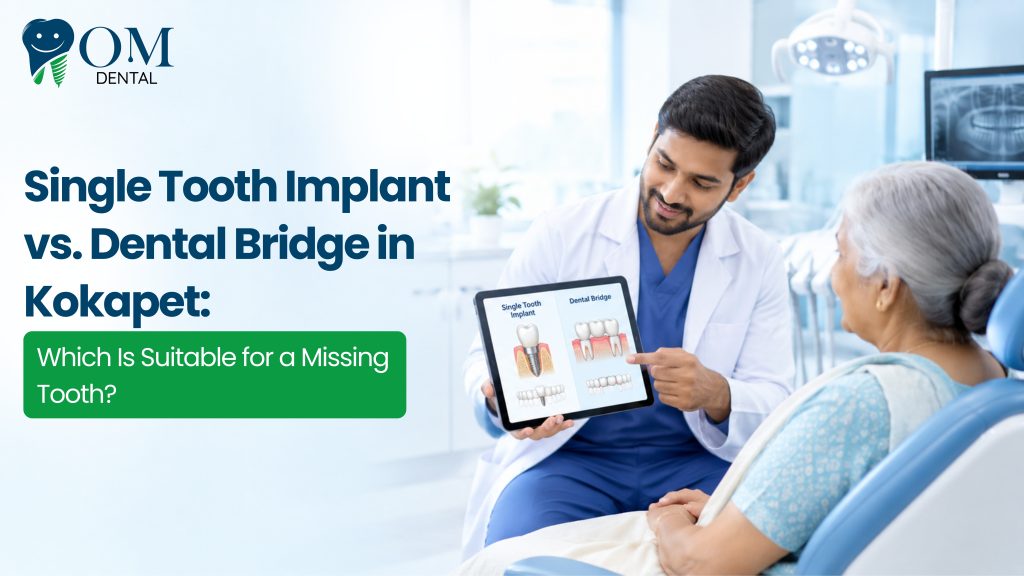
Single Tooth Implant vs. Dental Bridge in Kokapet: Which Is Suitable for a Missing Tooth?
Losing a single tooth can affect your smile, chewing ability, and overall oral comfort. When a tooth is missing, leaving the gap untreated may also allow nearby teeth to shift over time. Fortunately, there are several tooth replacement options available today. Two commonly considered choices are a single tooth implant and a dental bridge. If you are looking for a tooth implant in Kokapet, understanding how implants and bridges differ can help you discuss the right option with your dentist. Both treatments can restore a missing tooth, but they work in different ways and have different requirements. OM Dental in Kokapet, Hyderabad, provides dental implant and restorative dental treatments based on individual oral health needs. The clinic also offers crowns and bridges as part of its restorative dental care. Choosing Between an Implant and a Bridge A single tooth implant is designed to replace both the missing tooth and its root. A small implant is placed into the jawbone and later supports a dental crown. This allows the replacement tooth to function independently without relying on the neighbouring teeth for support. A dental bridge, on the other hand, replaces the visible portion of the missing tooth while using the adjacent teeth as support. A traditional bridge usually consists of a replacement tooth connected to crowns placed over the neighbouring teeth. Both options can provide a fixed replacement for a missing tooth. However, the choice depends on factors such as the condition of the surrounding teeth, available jawbone, gum health, treatment timeline, and long-term oral health goals. How a Single Tooth Implant Restores a Missing Tooth? A single tooth implant involves several stages. First, the dentist examines the missing-tooth area and evaluates the gums and jawbone. Dental X-rays or other imaging may be used to determine whether there is sufficient bone for implant placement. Once the area is suitable, the implant is placed into the jawbone. The implant gradually integrates with the surrounding bone during the healing period. After the healing process, an abutment and custom dental crown are placed to complete the restoration. One important benefit of this approach is that the implant acts as an artificial tooth root. It provides support for the crown and can help maintain the bone in the area of the missing tooth. Patients considering a single tooth implant in Kokapet can discuss their bone condition, implant suitability, expected treatment timeline, and restoration options during a dental consultation. How a Dental Bridge Fills the Tooth Gap? A dental bridge is another fixed solution for replacing a missing tooth. In a conventional bridge, the teeth on either side of the gap are prepared to support dental crowns. The replacement tooth is connected between these crowns, creating a bridge across the missing-tooth space. One advantage of a dental bridge is that it does not require implant placement into the jawbone. This can make the treatment process different from implant treatment. A dental bridge in Kokapet may be considered when the neighbouring teeth are healthy enough to provide support and when a patient prefers a fixed restoration without undergoing implant placement. However, the supporting teeth need to be carefully evaluated before treatment. If the adjacent teeth have significant decay, gum disease, mobility, or other problems, a bridge may not always be the preferred option. Important Differences Between the Two Treatments Although both treatments can replace one missing tooth, there are several differences to consider. Effect on Neighbouring Teeth A single tooth implant is independently supported by the jawbone. Healthy neighbouring teeth generally do not need to be reduced to support the implant crown. With a conventional dental bridge, the neighbouring teeth are usually prepared so that crowns can be placed over them. For patients with healthy adjacent teeth, preserving their natural tooth structure may be an important consideration. Support for the Jawbone A missing tooth no longer provides natural root stimulation to the jawbone. Over time, this can contribute to bone loss in the area. Because an implant is placed into the jawbone, it can provide root-like support and may help maintain the bone around the missing tooth. A traditional bridge replaces the visible tooth but does not replace the missing root. Treatment Duration The treatment timeline is another difference. A dental bridge can generally be planned and completed without waiting for an implant to integrate with the jawbone. The exact time depends on the condition of the supporting teeth and the restoration required. Dental implant treatment usually takes longer because the implant needs time to heal and integrate with the jawbone before the final crown is placed. Appearance and Function Both implants and bridges can be designed to match the surrounding teeth. A well-made restoration can improve the appearance of the smile and help restore chewing function. A dental implant-supported crown is independently positioned in the missing-tooth area, while a bridge connects the replacement tooth to the supporting teeth. When an Implant May Be the Preferred Option? A single tooth implant may be considered when a patient wants an independent tooth replacement and has suitable bone and gum health. An implant may be particularly appealing when: However, an implant is not automatically suitable for everyone. Bone condition, gum health, oral hygiene, bite, and other clinical factors should be assessed before treatment. Situations Where a Dental Bridge May Be Considered A dental bridge may be an appropriate option for patients who have suitable supporting teeth and want a fixed replacement without implant surgery. A bridge may be considered when: The dentist will evaluate the condition of the teeth around the missing space before recommending a bridge. Benefits of Choosing a Single Tooth Implant When clinically suitable, a single tooth implant offers several potential advantages. Independent Tooth Replacement The implant does not normally depend on the adjacent natural teeth for support. Natural-Looking Restoration A custom-made crown can be designed to match the colour, shape, and size of the surrounding teeth. Jawbone Support The implant is positioned in the jawbone and provides support similar to a natural tooth root.