
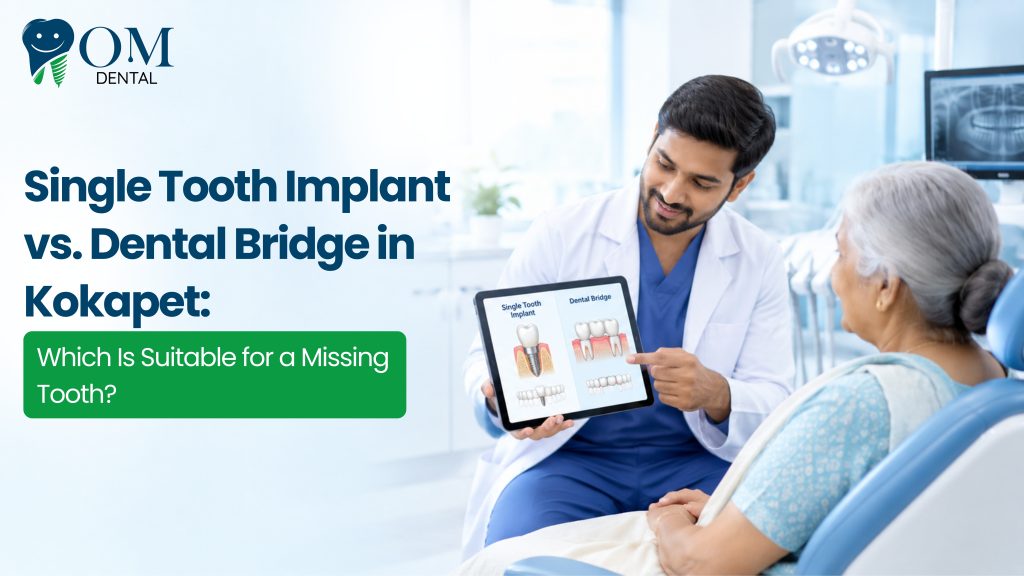
Losing a single tooth can affect your smile, chewing ability, and overall oral comfort. When a tooth is missing, leaving the gap untreated may also allow nearby teeth to shift over time. Fortunately, there are several tooth replacement options available today. Two commonly considered choices are a single tooth implant and a dental bridge.
If you are looking for a tooth implant in Kokapet, understanding how implants and bridges differ can help you discuss the right option with your dentist. Both treatments can restore a missing tooth, but they work in different ways and have different requirements.
OM Dental in Kokapet, Hyderabad, provides dental implant and restorative dental treatments based on individual oral health needs. The clinic also offers crowns and bridges as part of its restorative dental care.
Choosing Between an Implant and a Bridge
A single tooth implant is designed to replace both the missing tooth and its root. A small implant is placed into the jawbone and later supports a dental crown. This allows the replacement tooth to function independently without relying on the neighbouring teeth for support.
A dental bridge, on the other hand, replaces the visible portion of the missing tooth while using the adjacent teeth as support. A traditional bridge usually consists of a replacement tooth connected to crowns placed over the neighbouring teeth.
Both options can provide a fixed replacement for a missing tooth. However, the choice depends on factors such as the condition of the surrounding teeth, available jawbone, gum health, treatment timeline, and long-term oral health goals.
How a Single Tooth Implant Restores a Missing Tooth?
A single tooth implant involves several stages. First, the dentist examines the missing-tooth area and evaluates the gums and jawbone. Dental X-rays or other imaging may be used to determine whether there is sufficient bone for implant placement.
Once the area is suitable, the implant is placed into the jawbone. The implant gradually integrates with the surrounding bone during the healing period. After the healing process, an abutment and custom dental crown are placed to complete the restoration.
One important benefit of this approach is that the implant acts as an artificial tooth root. It provides support for the crown and can help maintain the bone in the area of the missing tooth.
Patients considering a single tooth implant in Kokapet can discuss their bone condition, implant suitability, expected treatment timeline, and restoration options during a dental consultation.
How a Dental Bridge Fills the Tooth Gap?
A dental bridge is another fixed solution for replacing a missing tooth. In a conventional bridge, the teeth on either side of the gap are prepared to support dental crowns. The replacement tooth is connected between these crowns, creating a bridge across the missing-tooth space.
One advantage of a dental bridge is that it does not require implant placement into the jawbone. This can make the treatment process different from implant treatment.
A dental bridge in Kokapet may be considered when the neighbouring teeth are healthy enough to provide support and when a patient prefers a fixed restoration without undergoing implant placement.
However, the supporting teeth need to be carefully evaluated before treatment. If the adjacent teeth have significant decay, gum disease, mobility, or other problems, a bridge may not always be the preferred option.
Important Differences Between the Two Treatments
Although both treatments can replace one missing tooth, there are several differences to consider.
Effect on Neighbouring Teeth
A single tooth implant is independently supported by the jawbone. Healthy neighbouring teeth generally do not need to be reduced to support the implant crown.
With a conventional dental bridge, the neighbouring teeth are usually prepared so that crowns can be placed over them.
For patients with healthy adjacent teeth, preserving their natural tooth structure may be an important consideration.
Support for the Jawbone
A missing tooth no longer provides natural root stimulation to the jawbone. Over time, this can contribute to bone loss in the area.
Because an implant is placed into the jawbone, it can provide root-like support and may help maintain the bone around the missing tooth.
A traditional bridge replaces the visible tooth but does not replace the missing root.
Treatment Duration
The treatment timeline is another difference.
A dental bridge can generally be planned and completed without waiting for an implant to integrate with the jawbone. The exact time depends on the condition of the supporting teeth and the restoration required.
Dental implant treatment usually takes longer because the implant needs time to heal and integrate with the jawbone before the final crown is placed.
Appearance and Function
Both implants and bridges can be designed to match the surrounding teeth. A well-made restoration can improve the appearance of the smile and help restore chewing function.
A dental implant-supported crown is independently positioned in the missing-tooth area, while a bridge connects the replacement tooth to the supporting teeth.
When an Implant May Be the Preferred Option?
A single tooth implant may be considered when a patient wants an independent tooth replacement and has suitable bone and gum health.
An implant may be particularly appealing when:
- The neighbouring teeth are healthy and should ideally remain untouched.
- There is sufficient jawbone for implant placement.
- The patient wants a fixed tooth replacement.
- The patient is comfortable with a longer treatment process.
- Long-term tooth replacement is an important consideration.
However, an implant is not automatically suitable for everyone. Bone condition, gum health, oral hygiene, bite, and other clinical factors should be assessed before treatment.
Situations Where a Dental Bridge May Be Considered
A dental bridge may be an appropriate option for patients who have suitable supporting teeth and want a fixed replacement without implant surgery.
A bridge may be considered when:
- The neighbouring teeth can adequately support the restoration.
- The patient prefers to avoid implant surgery.
- A fixed replacement is preferred over a removable option.
- The patient wants to complete treatment without waiting for implant integration.
- The supporting teeth already require crowns or substantial restoration.
The dentist will evaluate the condition of the teeth around the missing space before recommending a bridge.
Benefits of Choosing a Single Tooth Implant
When clinically suitable, a single tooth implant offers several potential advantages.
Independent Tooth Replacement
The implant does not normally depend on the adjacent natural teeth for support.
Natural-Looking Restoration
A custom-made crown can be designed to match the colour, shape, and size of the surrounding teeth.
Jawbone Support
The implant is positioned in the jawbone and provides support similar to a natural tooth root.
Fixed and Stable
An implant-supported crown is fixed in place and can help restore everyday chewing function.
Long-Term Oral Health Consideration
With good oral hygiene and regular dental checkups, an implant can provide a long-term tooth replacement solution for suitable patients.
Benefits of Choosing a Dental Bridge
Dental bridges also provide practical benefits for selected patients.
Fixed Restoration
A bridge remains fixed in the mouth and can restore the appearance of a missing tooth.
No Implant Placement
Unlike an implant, a conventional bridge does not require an implant to be surgically placed into the jawbone.
Fills the Missing-Tooth Gap
A bridge can restore the continuity of the dental arch and improve the appearance of the smile.
Useful When Supporting Teeth Are Suitable
If the neighbouring teeth are strong enough to support the bridge, it can be an effective restorative option.
Factors to Discuss With Your Dentist
Choosing between a tooth implant and dental bridge should not be based only on cost or treatment duration. Several clinical factors need to be considered.
Your dentist may assess:
- Condition of the jawbone
- Gum health
- Health of neighbouring teeth
- Bite and chewing pattern
- Location of the missing tooth
- Oral hygiene
- Existing dental restorations
- Expected treatment timeline
- Long-term dental goals
A dental examination and appropriate imaging can help determine which treatment is more suitable for your particular situation.
Comparing Tooth Implant and Dental Bridge
| Feature | Single Tooth Implant | Dental Bridge |
| Replaces missing tooth | Yes | Yes |
| Replaces tooth root | Yes | No |
| Requires implant placement | Yes | No |
| Uses neighbouring teeth for support | Generally no | Usually yes |
| Supports jawbone | Can help maintain bone | Does not replace the root |
| Fixed restoration | Yes | Yes |
| Healing period | Required | No implant healing required |
| Suitable for everyone | No | No |
Why Choose OM Dental for Tooth Replacement in Kokapet?
OM Dental provides dental care in Kokapet, Hyderabad, including implant treatment, crowns, bridges, and other restorative procedures. The clinic uses diagnostic evaluation and personalized treatment planning to determine appropriate options for individual patients.
If you are considering a tooth implant in Kokapet, you can discuss implant placement, bone condition, crown options, and the expected treatment process with the dental team.
For patients considering a dental bridge in Kokapet, the clinic can also assess the neighbouring teeth and explain whether a bridge can provide adequate support.
OM Dental also provides other restorative and cosmetic dental treatments, including crowns and bridges and dental implants.
Frequently Asked Questions
Is a single tooth implant better than a dental bridge?
Neither option is automatically better for every patient. An implant may be preferred when healthy neighbouring teeth should be preserved, while a bridge may be suitable when the adjacent teeth can provide strong support.
How long does a single tooth implant take?
The complete process can take several months because the implant needs time to integrate with the jawbone before the final crown is placed. The exact timeline varies according to individual healing and treatment requirements.
Does a dental bridge require surgery?
A conventional dental bridge does not require implant surgery. However, the supporting teeth generally need to be prepared before the bridge is placed.
Can a missing tooth be replaced immediately with an implant?
Immediate implant placement may be possible in selected cases. The dentist must first evaluate the extraction area, bone condition, gum health, and other factors.
How do I know whether I need an implant or bridge?
A dental examination is the best way to determine the suitable option. Your dentist can assess your jawbone, gums, neighbouring teeth, bite, and overall oral health before recommending treatment.
Restore Your Missing Tooth in Kokapet
A missing tooth does not have to permanently affect your smile or chewing ability. Both single tooth implants and dental bridges can provide fixed tooth replacement, but they have different treatment approaches and requirements.
If you are comparing a tooth implant and dental bridge in Kokapet, consult a qualified dentist for an individual evaluation. OM Dental can assess the missing-tooth area and discuss suitable treatment options based on your oral health, surrounding teeth, bone condition, and long-term requirements.
Visit Here: https://omdentalhyderabad.com